


Welcome to KIMIAS — one idea has been lingering with me for a long time, and the World Cup reinforced it. Foods across East Asian and Western European cultures and how often distinct peoples, separated by a continents, land and sea, cooked their way to the exact same idea.
I have to start with the reason I finally sat down to write this.
The World Cup's over now, but the thing that stuck with me wasn't a goal. It was the advertising. The whole machine around this tournament was reaching for one idea, over and over. FIFA built the entire thing on the slogan "We Are 26" — three countries, a whole continent, in Infantino's words "united as one to welcome the world." Adidas ran "Backyard Legends," where street kids and all-time greats end up playing the same game on the same scrappy pitch. EE built a campaign around belonging — the confidence a kid finds not from anything online but from a team, a coach, people who make room for him.
Strip the logos off and it's all the same message: the same game, played everywhere, by everyone, and nobody had to be taught to want it. Different jerseys, one game.
The tournament ended and that idea didn't let go of me. Because that's exactly what I'm trying to do — just with bags and food instead of a ball. Find the thing that shows up in two places that never talked to each other, and let the sameness speak for itself.
Because here's the premise. Cultures that never met, working with what the land gave them, keep arriving at the same dish. Not "inspired by." Not "fusion." Independently. The same solution to the same problem — cold winters, cheap starch, leftover cuts, hungry people. Strip away the language, the seasoning, the story each culture tells about itself, and the thing underneath is the same thing. Same bones — just different dressing. We're one people, cooking the same food, dressed differently. This goes to the underlying values of KIMIAS.
Let me show you three. The first two you can see on the table. The third is hiding underneath it.
1. Ongsimi ↔ Gnocchi

Gangwon Province, Korea. Cold, mountainous, potato country. You grate the potato, pull the starch, and roll it into little dense chewy dumplings that go into a broth.
Northern Italy. Also cold. Also mountainous. Also potato country. You take the potato, work it into dough, and shape little pieces that go into sauce.
Same starch. Same form. Same reason it exists — a highland farming culture stretching a humble root into a full meal. Two grandmothers, a continent apart, hand-rolling the same dumpling.
The only real divergence is the last step: Korea drops it in liquid, Italy dresses it on top. That's not an ingredient difference. That's a grammar difference — the deep structure of how each cuisine finishes a dish. Broth culture vs. sauce culture. Same noun, different verb.
Same mountain, different bowl.
2. Pâté ↔ The Liver That Comes With Soondae

This one's about organ meat and dignity.
Pâté is what happens when a culture decides the "throwaway" cuts — liver especially — deserve real care. You treat it, you enrich it, you serve it cold, and somehow the cheapest part of the animal becomes a thing people crave. Crucially, in its rustic country form, pâté is not fine dining. It's market food. Everyday luxury.
Korea has the same move, and it's sitting right next to your soondae. The slices of steamed pork liver (and lung) you get on the side, eaten with a little salt. Same organ. Same "we didn't waste this, we honored it" instinct. Same register — this is street food, pojangmacha food, not white-tablecloth food.
The gap: pâté is smooth and spreadable, the soondae liver is sliced. But rustic country pâté is barely smooth anyway. On the axis that matters — cheap organ meat elevated into something people love, at the everyday level — it's a direct hit.
3. Aekjeot ↔ Colatura di Alici
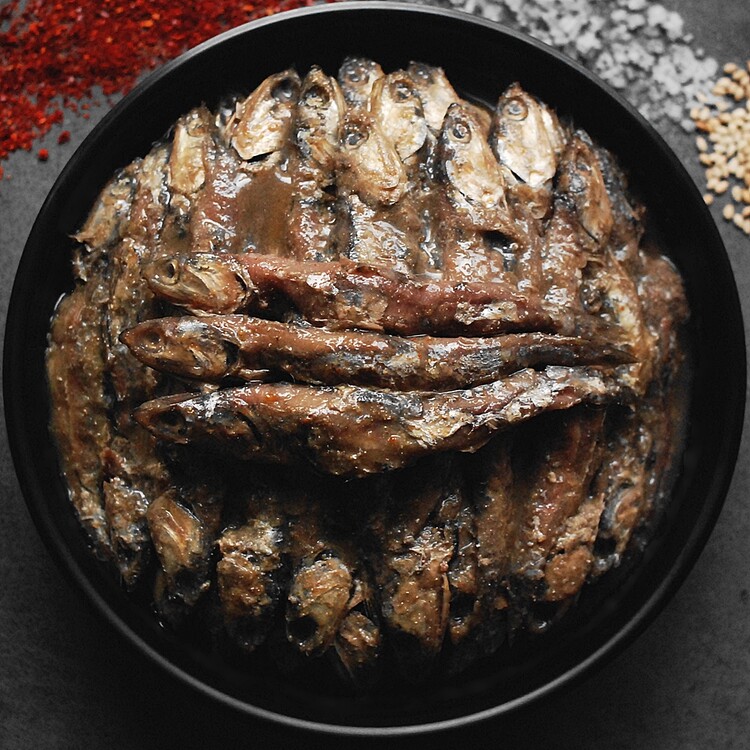
This is the one that goes deepest, because it isn't a dish you can point to on the table. It's underneath everything on the table.
Ancient Rome ran on garum — fish, salted and fermented until it broke down into a thin, savage, savory liquid that went into nearly everything they ate. Rome fell; the sauce didn't. It survived on the Amalfi coast as colatura di alici, the amber liquid pressed from anchovies packed in salt in the village of Cetara. Still made. Still spooned over pasta today.
Korea has been doing the identical thing for centuries: aekjeot — fish sauce, most often myeolchi aekjeot, pressed from salted, fermented anchovies. It's the quiet backbone of kimchi, of stews, of half the banchan on the table.
Sit with that. Two civilizations, no contact, both took the anchovy, both buried it in salt, both waited, and both pulled out the same amber umami and built their entire flavor world on top of it. Not a similar dish — the same technique, on the same fish, for the same reason.
And here's the something more. The first two pairs were things you can see: a dumpling, a slice of liver. This one is invisible — it's the base note under the music. Which means the convergence isn't just in what two cultures cooked. It's in how they each learned to make food taste like more of itself, and they reached, independently, for the exact same trick. At some point that stops being coincidence and starts feeling like a law.
Same sea, different bottle.
The part that matters
The best of these equivalents don't live in a database. They live in memory — in someone who's actually eaten the thing. Someone who knows the liver comes with the soondae because they've picked it off the plate with a toothpick. Someone who could taste colatura in a Korean stew and feel, before they could explain it, that they'd met it somewhere before. The obvious right answer belongs to the person who's been to the table, not the one who's read about it.
That's what KIMIAS is. Taste leads. The framing follows.
And that's what those ads were doing, isn't it. "We Are 26" doesn't argue that Korea and Italy play the same. It just puts everyone on the same field and trusts you to feel it. Backyard Legends doesn't explain why a street kid and a legend belong in the same frame — it just frames them together. Different jerseys, one game. Different bowls, one dish.
That's the job. Put ongsimi next to gnocchi, liver next to liver, and get out of the way.
More pairs soon. Bring me your own — the two dishes that are secretly the same dish. I want the ones you know, not the ones you can look up.
— KIMIAS